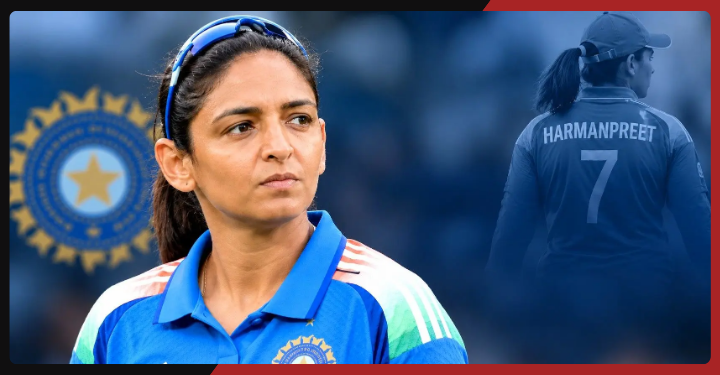
Harmanpreet Kaur’s decision to step down as captain of the Indian women’s cricket team across all formats has opened the door to a major leadership transition, with Smriti Mandhana emerging as one of the strongest candidates to take over the responsibility. Harmanpreet announced her decision following a BCCI review meeting, ending a long captaincy tenure that helped define a transformative period for Indian women’s cricket.
The decision means the Indian team will now enter a new leadership era. While Harmanpreet is expected to remain available as a player, the responsibility of guiding India through future international assignments will move to another member of the squad. Among the names likely to attract the most attention is Smriti Mandhana, who has already established herself as one of the most influential players in Indian women’s cricket.
Mandhana has considerable international experience and has been a key member of the Indian team for years. Her calm personality, consistency with the bat and experience in high-pressure matches have made her an important figure in the dressing room. If appointed captain, she would inherit a team that has recently experienced both historic success and significant expectations.
Harmanpreet’s decision followed a review meeting in Guwahati attended by BCCI secretary Devajit Saikia, head coach Amol Muzumdar, Harmanpreet and vice-captain Mandhana. The meeting examined the team’s recent performances and discussed the roadmap for Indian women’s cricket. The captaincy transition is therefore likely to be an important part of the board’s broader plans for the team’s future.
For Mandhana, taking charge would represent a significant new responsibility. Captaincy at international level involves far more than leading the team onto the field. The new captain will have to manage a changing squad, communicate with the coaching staff, handle expectations and maintain the confidence of players across all three formats.
The transition could also provide an opportunity to develop a new leadership culture within the team. Harmanpreet’s tenure was closely associated with an aggressive and emotionally charged style of leadership. Mandhana, by contrast, has generally been regarded as composed and measured. A change in leadership personality could give India a different tactical and strategic approach without necessarily requiring a major change in the team’s overall identity.
Harmanpreet’s continued presence could be particularly useful during this period. Although she will no longer carry the captaincy, her experience of leading India for many years could provide valuable support to the next captain. Having played alongside Mandhana for a significant portion of their international careers, Harmanpreet understands the pressures that come with the role.
The change also comes at an important moment for the Indian team. Expectations around women’s cricket have grown dramatically, particularly after India’s historic Women’s ODI World Cup triumph under Harmanpreet’s leadership. That achievement raised the profile of the national team and increased expectations surrounding its future performances.
The next captain will therefore face a difficult balancing act. India will be expected to continue competing for major international trophies while simultaneously developing younger players. The leadership group will need to ensure that the success of the previous era becomes a foundation rather than a source of pressure.
Mandhana’s experience across different formats could be an advantage. The demands of Test cricket are very different from those of T20 internationals, while ODI cricket requires its own tactical approach. An all-format captain must be capable of adapting quickly and communicating different plans to the squad.
The BCCI has yet to formally announce the successor, meaning speculation around the next captain is likely to continue until an official decision is made. However, Mandhana’s existing position within the leadership group makes her an obvious candidate.
The possibility of a Mandhana-led India also represents a generational shift. Harmanpreet became one of the central figures of Indian women’s cricket during a period when the sport was rapidly professionalising. Mandhana belongs to a generation that grew alongside that transformation and could now be asked to lead its next phase.
For Indian supporters, the transition will be watched closely. Leadership changes can influence team dynamics, selection decisions and the roles of senior players. At the same time, a new captain can bring fresh ideas and renewed energy into the dressing room.
Harmanpreet’s departure from the leadership role should not necessarily be viewed as the end of her influence. Her experience, particularly in major tournaments and difficult international situations, can remain an important resource for the team.
Ultimately, the BCCI’s decision will determine the direction of Indian women’s cricket in the coming years. Whoever receives the captaincy will inherit a side with considerable talent, a growing fan base and expectations created by recent success.
For Smriti Mandhana, the opportunity could become the biggest leadership assignment of her career. If she is chosen, her challenge will be to build on Harmanpreet Kaur’s legacy while establishing an identity of her own.
The end of Harmanpreet’s captaincy therefore marks more than a change in name at the top. It is the beginning of a new chapter, one in which a new leader will be expected to carry Indian women’s cricket forward while the former captain remains an experienced presence within the team.
Journalist Details


- Jitendra Kumar is an Indian journalist and social activist from Hathras in Uttar Pradesh is known as the senior journalist and founder of Xpert Times Network Private Limited.
Latest entries