
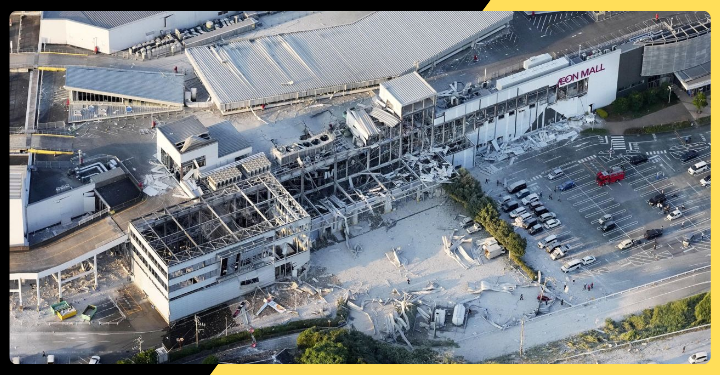
Japan was struck by a powerful magnitude 7.1 earthquake that quickly turned into a devastating national emergency after a massive explosion ripped through a busy shopping mall. The twin disaster claimed several lives, injured dozens of people, and left rescue teams racing against time to search for survivors trapped beneath collapsed debris. The incident once again highlighted the destructive force of earthquakes and the unpredictable chain of events they can trigger, even in one of the world’s most earthquake-prepared nations.
The earthquake struck during a busy period when offices, schools, restaurants, and shopping centres were filled with people. Within seconds, buildings began shaking violently, sending residents scrambling for safety. Shelves collapsed inside supermarkets, office furniture toppled over, and traffic came to a standstill as drivers pulled over to avoid accidents. Emergency alerts were immediately sent to mobile phones across the affected region, warning citizens to seek shelter and prepare for possible aftershocks.
As the shaking subsided, many believed the worst was over. However, only moments later, a powerful explosion tore through a large shopping mall, creating scenes of panic and destruction. Witnesses reported hearing an enormous blast followed by clouds of thick smoke rising into the sky. The force of the explosion shattered windows hundreds of metres away, while parts of the building’s exterior collapsed onto nearby roads.
People who had been inside the mall described terrifying moments as ceilings gave way and debris rained down around them. Many shoppers rushed towards emergency exits while others became trapped under fallen concrete and twisted steel. Store employees helped customers escape despite the danger, guiding families and elderly visitors through smoke-filled corridors. Several individuals sustained injuries from flying glass, falling objects, and the force of the explosion itself.
Emergency services arrived within minutes. Firefighters battled multiple fires that had broken out inside the damaged complex, while specialised rescue teams carefully entered unstable sections of the building searching for survivors. Rescue dogs, thermal imaging equipment, and heavy machinery were deployed to locate people trapped beneath the rubble. Medical personnel established emergency treatment areas near the site to stabilise victims before transferring them to hospitals.
Authorities have not officially confirmed the exact cause of the explosion, but early investigations suggest that underground gas infrastructure may have been damaged during the earthquake. Experts explained that strong seismic activity can rupture gas pipelines, electrical systems, and fuel storage facilities, creating dangerous conditions that may lead to fires or explosions if sparks are present. Investigators are examining the damaged site to determine what triggered the blast.
Hospitals across the region declared emergency protocols as ambulances continued arriving with injured victims. Doctors treated patients suffering from burns, fractures, head injuries, smoke inhalation, and cuts caused by shattered glass. Medical staff worked extended shifts to ensure everyone received immediate care, while blood donation centres appealed to the public for urgent support.
The Japanese government responded swiftly by activating national disaster management systems. Local authorities coordinated with police, firefighters, military personnel, and emergency medical teams to conduct rescue operations and restore public safety. Temporary shelters were opened for residents unable to return home because of structural damage or ongoing safety concerns.
Transportation networks experienced significant disruption throughout the affected area. High-speed rail services were suspended while engineers inspected tracks for possible damage. Several roads were closed because of cracks, fallen utility poles, and debris scattered across major intersections. Flights at nearby airports were delayed as runways and terminal facilities underwent safety inspections.
Utility companies worked continuously to restore essential services. Thousands of households temporarily lost electricity, while some neighbourhoods experienced interruptions to gas and water supplies. Communication networks also became overloaded as residents attempted to contact relatives, leading to temporary disruptions in mobile phone services.
Experts reminded the public that aftershocks often follow major earthquakes and can cause additional structural damage to already weakened buildings. Authorities urged residents to stay away from damaged structures, avoid unnecessary travel, and closely monitor official emergency updates.
The disaster has once again demonstrated both Japan’s vulnerability to powerful natural events and its remarkable emergency response capabilities. Although strict building codes and advanced warning systems have saved countless lives over the years, secondary incidents such as fires and explosions remain difficult to predict and prevent completely.
As rescue operations continue, families anxiously await news of missing loved ones while communities come together to support those affected. Volunteers have provided food, water, blankets, and emergency accommodation to displaced residents. The coming days will focus on recovery efforts, damage assessments, and determining the exact sequence of events that transformed a powerful earthquake into a deadly double disaster. Japan now faces the difficult task of rebuilding damaged infrastructure while mourning the lives lost in one of the country’s latest tragic emergencies.
Journalist Details

- Jitendra Kumar is an Indian journalist and social activist from Hathras in Uttar Pradesh is known as the senior journalist and founder of Xpert Times Network Private Limited.
Latest entries
 Latest NewsSeptember 30, 2026Flydubai Emergency: Pilots Hospitalised After Flight Diverted From Tel Aviv to Saudi Arabia
 NewsSeptember 29, 2026Essar’s $18 Billion US Investment Links Minnesota Iron Ore Mine to Iowa Steel Mill
 Latest NewsSeptember 28, 2026Delhi to Double Parking Charges From November 1 as Winter Smog Measures Expand
 Latest NewsSeptember 27, 2026LPU Unrest Escalates From Campus Protest to Highway Blockade as Police Investigate Rape Allegation