
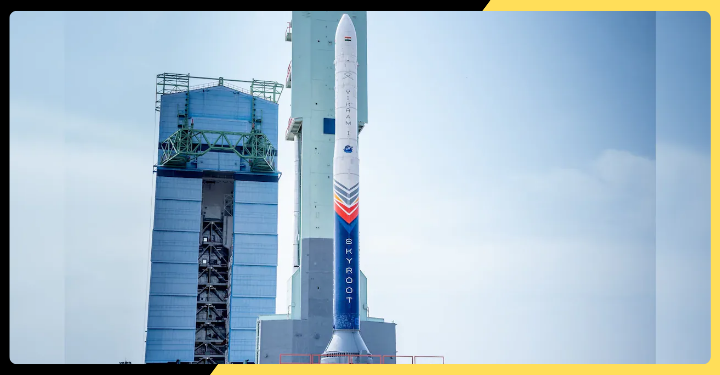
The successful orbital mission of Vikram-1 marks a defining chapter in India’s rapidly evolving private space industry. For Skyroot Aerospace, the achievement is far more than a technological victory—it is proof that Indian startups are capable of designing, building, and launching sophisticated rockets that can compete on the global stage. Yet while Vikram-1 has captured headlines and inspired optimism about the country’s growing space ambitions, the company’s toughest mission is only beginning. To become a lasting success story, Skyroot must now prove it can thrive in the fiercely competitive commercial launch market.
India has long been recognized for its achievements in space exploration through the Indian Space Research Organisation (ISRO). From cost-effective satellite launches to ambitious lunar and Mars missions, the country has built a reputation for delivering high-quality space missions at relatively low costs. However, the rise of private companies like Skyroot represents a new phase in India’s space journey. Instead of relying solely on government-led programs, the nation is encouraging private enterprises to develop innovative technologies, attract investment, and participate in the global space economy.
Skyroot has emerged as one of the pioneers of this transformation. Founded by former ISRO engineers, the company was established with the vision of making space access easier, faster, and more affordable. Over the years, it has developed advanced rocket technologies, including lightweight composite structures, 3D-printed engine components, and modular launch systems designed for the growing small satellite market. Vikram-1 is the culmination of years of engineering, testing, and innovation, demonstrating that the company’s technology is capable of reaching orbit.
However, reaching orbit is only one measure of success in today’s commercial space industry. Customers are interested not just in whether a rocket works, but whether it can launch consistently, safely, and on schedule. Satellite operators often invest millions of dollars in their payloads, making reliability one of the most important factors when selecting a launch provider. Even a single launch failure can damage a company’s reputation and affect its ability to secure future contracts.
One of Skyroot’s biggest opportunities lies in the booming small satellite industry. Advances in satellite technology have made spacecraft smaller, cheaper, and more capable than ever before. Governments, universities, research organizations, telecommunications companies, and Earth observation firms are launching increasing numbers of satellites to support communications, navigation, climate monitoring, disaster response, and scientific research. Industry analysts expect this demand to continue growing throughout the decade, creating significant opportunities for dedicated launch providers.
Dedicated launch services offer several advantages over traditional rideshare missions. Customers gain greater flexibility in choosing launch dates, orbital destinations, and mission requirements without waiting for larger rockets to accommodate multiple payloads. This niche market aligns well with Skyroot’s strategy of offering responsive and customized launch solutions for smaller satellites.
Despite these opportunities, commercial competition remains intense. International companies are investing heavily in reusable rockets, automated manufacturing, and large-scale production to reduce costs and increase launch frequency. Established players have already built strong customer relationships and demonstrated consistent operational performance over multiple years. For Skyroot, competing against these experienced companies will require not only technological excellence but also exceptional business execution.
Financial sustainability presents another major challenge. Rocket development demands continuous investment in research, testing, manufacturing, quality assurance, and skilled talent. After achieving a successful orbital launch, expectations from investors naturally increase. Venture capital firms and strategic investors now expect Skyroot to convert its technological achievements into commercial success by securing long-term launch contracts and generating recurring revenue.
Government reforms have played a crucial role in creating opportunities for private space companies. India’s decision to encourage private participation has led to improved regulatory frameworks, access to infrastructure, and greater collaboration between startups and national space institutions. These initiatives have strengthened investor confidence while positioning India as an emerging destination for commercial space innovation.
Building a resilient supply chain will also be essential for Skyroot’s future growth. Manufacturing rockets involves thousands of specialized components sourced from numerous suppliers. Ensuring consistent quality, timely production, and cost efficiency becomes increasingly important as launch frequency rises. Scaling production while maintaining high safety standards is one of the most demanding aspects of commercial aerospace operations.
Another area where Skyroot can strengthen its business is by expanding beyond launch services. Offering satellite integration, mission planning, orbital deployment, and future in-space logistics solutions could diversify revenue streams while providing customers with comprehensive mission support. Such integrated services are becoming increasingly valuable in the evolving global space economy.
International expansion also represents an attractive opportunity. Many countries lack domestic launch capabilities and rely on commercial providers to place satellites into orbit. By building a reputation for reliability, competitive pricing, and responsive customer service, Skyroot could attract clients from Asia, Europe, Africa, and other emerging space markets.
The successful Vikram-1 mission has undoubtedly transformed Skyroot Aerospace from a promising startup into a recognized player in the global launch industry. However, history has shown that many companies achieve technical breakthroughs without becoming commercially successful. Sustained growth requires operational excellence, financial discipline, customer trust, and continuous innovation.
India’s private space dream has truly taken flight with Vikram-1. The mission symbolizes the country’s growing confidence in private enterprise and technological innovation. The next challenge for Skyroot is not simply launching more rockets—it is winning the commercial race by building a reliable, profitable, and globally competitive space business. If the company succeeds, it will not only shape its own future but also help define the future of India’s private space industry for decades to come.
Journalist Details

- Jitendra Kumar is an Indian journalist and social activist from Hathras in Uttar Pradesh is known as the senior journalist and founder of Xpert Times Network Private Limited.
Latest entries
 Crime NewsOctober 13, 2026Hyderabad Police Investigate Suspicious Death of 29-Year-Old Software Engineer
 World NewsOctober 11, 2026Hydropower Project and Bridges Damaged as Nepal Floodwaters Surge
 Latest NewsOctober 10, 2026Delhi on High Alert as CJP Protest Draws Attention to Electoral Roll Revision Controversy
 Latest NewsOctober 8, 2026Fresh FIRs Against Rahul and Priyanka Gandhi Add Fuel to Escalating SIR Protests