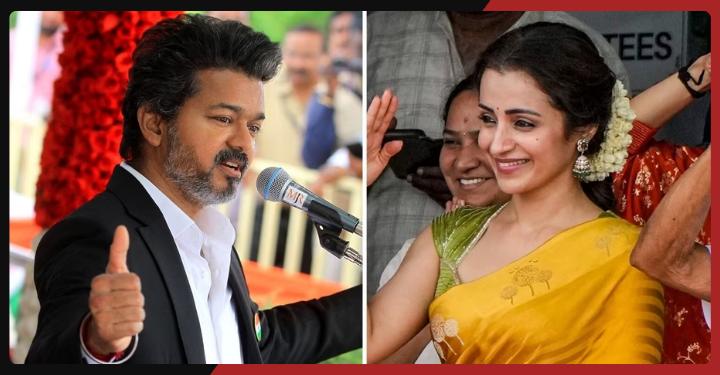
Tamil Nadu Chief Minister C. Joseph Vijay gave his criticism of abusive language against women a powerful historical dimension when he invoked the humiliation faced by former Chief Minister J. Jayalalithaa in the Tamil Nadu Assembly.
Speaking during a discussion in the Assembly, Vijay condemned what he described as degrading, defamatory and double-meaning language directed at women. His comments came amid the political controversy surrounding remarks allegedly linked to actor Trisha Krishnan.
While Vijay did not directly name Opposition leader Udhayanidhi Stalin, his remarks were widely seen as a response to the recent controversy.
However, Vijay’s reference to Jayalalithaa transformed the moment into something larger than the immediate political dispute.
Jayalalithaa remains one of the most influential political figures in Tamil Nadu’s history. Her political career was marked by intense rivalry, personal attacks and fierce battles inside and outside the Assembly.
The 1989 Assembly incident involving Jayalalithaa remains a deeply remembered moment in Tamil Nadu politics and has often been cited in discussions about the treatment of women in public life.
By invoking that history, Vijay appeared to send a message that political institutions must learn from the past.
He suggested that Tamil Nadu had already witnessed how a woman political leader could face humiliation and disrespect in a political environment dominated by intense rivalry.
His argument was that society should not repeat such mistakes.
Vijay maintained that political criticism was perfectly legitimate. Democracy, after all, depends on disagreement. Governments must be questioned, opposition parties must challenge those in power and leaders must be held accountable.
But the Chief Minister drew a distinction between criticism and humiliation.
According to Vijay, attacking someone’s policies or political decisions is part of democratic debate. Attacking their dignity, particularly through vulgar language or double meanings, is something entirely different.
His statement also reflected a wider concern about modern political communication.
Today, speeches are immediately recorded, clipped and circulated through social media. A single controversial sentence can reach millions of people within minutes.
This makes the language used by political leaders even more important.
Vijay warned that people were closely watching political leaders and the language they used. He criticised what he described as a growing “river” of obscenity and hatred in public discourse.
The timing of his remarks gave them particular significance.
The controversy surrounding Trisha had already created tension between the ruling TVK and opposition DMK. The dispute emerged after comments made during a Cauvery protest were interpreted by critics as an inappropriate reference to the actor.
Udhayanidhi Stalin has denied making any objectionable statement about Trisha and has maintained that his comments were misunderstood.
Yet Vijay chose not to focus exclusively on the competing versions of that particular incident.
Instead, he used the moment to establish a larger principle: women should not become targets of political abuse.
His reference to Jayalalithaa strengthened that argument by connecting present-day political behaviour to Tamil Nadu’s history.
For many observers, the speech was also a reflection of Vijay’s attempt to define his own political leadership.
As a relatively new political force that has risen rapidly to power, Vijay and his TVK government are under pressure to establish their identity and governing philosophy.
By taking a strong stand on women’s dignity, Vijay has attempted to present his leadership as one that rejects personal humiliation in political debate.
The political arguments surrounding the Trisha controversy may continue.
But Vijay’s invocation of Jayalalithaa has ensured that the discussion is now connected to a larger historical question: whether Tamil Nadu’s political culture has truly moved beyond the treatment of women that has caused outrage in the past.
His message was ultimately a warning to all sides—political competition may continue, but dignity should never become collateral damage.
Journalist Details


Latest entries