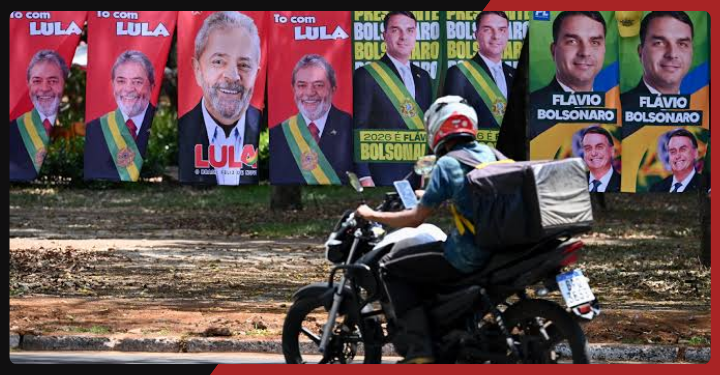
Brazil’s presidential election has tightened significantly, with projections indicating that former President Jair Bolsonaro is unlikely to secure an outright victory in the first round. His early advantage narrowed as additional votes were counted, bringing the election closer to a runoff.
The result highlights the competitiveness of Brazil’s political landscape and underlines the difficulty of predicting the final outcome before the full vote is counted.
Bolsonaro remains one of Brazil’s most recognizable political figures. His return to the presidential contest has energized conservative voters while also mobilizing a strong opposition movement.
The former president’s campaign has focused on conservative policies, public security and economic concerns. His supporters argue that Brazil needs a change in direction and view Bolsonaro as the strongest candidate to provide it.
But his political opponents have presented the election as a choice between Bolsonaro’s conservative agenda and an alternative political vision. That division has produced a highly competitive contest.
The narrowing projection has increased the possibility of a runoff. Under Brazil’s electoral system, a second round is held if no presidential candidate obtains the required majority in the first round.
A runoff would dramatically reshape the campaign. Instead of competing against a large field of candidates, the two finalists would focus almost entirely on each other.
They would also have to reach voters who supported candidates eliminated in the first round. Those voters could become decisive in determining the winner.
Political parties will therefore face important strategic decisions. Candidates who fail to advance may become targets of negotiations as the leading campaigns seek endorsements and alliances.
The outcome could also influence Brazil’s economic direction. Investors will be watching closely for signals about government spending, fiscal discipline, taxation and business regulations.
Brazil’s economy is closely connected to global commodity markets, agriculture, energy and international trade. Changes in government policy can have significant implications for companies and investors.
The election also carries broader geopolitical importance. Brazil is the largest country in South America and one of the world’s most important emerging economies. Its president plays a major role in regional diplomacy and international discussions on climate change, trade and development.
Environmental policy is particularly significant because of the Amazon rainforest. Brazil’s decisions regarding deforestation, agricultural expansion and conservation attract global attention.
Public security is another major concern for voters. Bolsonaro has historically emphasized tougher crime policies, while his opponents have proposed different approaches to policing and social policy.
The election is therefore about more than personalities. It represents competing ideas about Brazil’s economy, society, institutions and international role.
As the count continues, campaigns will likely avoid declaring victory until official results are available. Projections can change as votes arrive from regions with different political preferences.
The shrinking margin is already changing the political narrative. Bolsonaro may still finish first in the initial round, but finishing ahead is not enough to guarantee victory.
If a runoff is confirmed, the candidates will have to begin a new campaign almost immediately. Their ability to attract moderate voters and supporters of defeated candidates could prove decisive.
For now, Brazil remains without a confirmed winner. The narrowing gap has ensured that the election will remain closely watched until the final votes are counted.
Journalist Details


Latest entries