
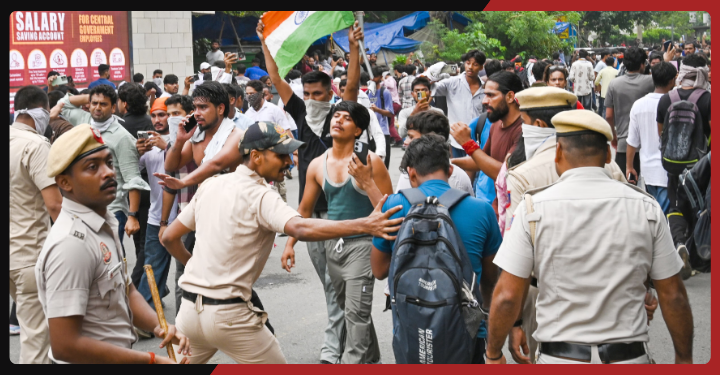
Delhi Police is adapting its protest-management strategy to a new digital reality in which almost every confrontation can be recorded and shared online. Following recent demonstrations at Jantar Mantar, police personnel have reportedly been given instructions on how to interact with Gen Z protesters without becoming part of viral social-media content.
The advisory reportedly tells officers to remain calm and avoid unnecessary engagement with demonstrators. If protesters attempt to start an argument, officers should not respond emotionally. Instead, they should either remain silent or use a short statement asking protesters to cooperate.
The instructions reflect a major change in the protest environment. In the past, a confrontation between a police officer and a demonstrator was largely witnessed by people physically present at the location. Today, the same confrontation can be recorded on a smartphone and reach a huge audience within minutes.
A facial expression can become a meme. A sentence can become a social-media caption. A short argument can become a reel. And a single moment can shape the public perception of an entire protest.
This is why the reported instruction that “your angry face is their content” is significant. Police personnel are being asked to understand that protesters may be interested not only in making their demands heard but also in documenting how authorities respond.
The guidelines reportedly caution officers against attempts to provoke emotional reactions. Protesters may cry, appeal personally to officers or raise questions about family circumstances and salaries. Officers have been told not to get involved in these conversations or show agreement.
The advisory also reportedly asks personnel to be especially careful when dealing with women protesters. Where possible, officers should avoid unnecessary physical contact, with women police personnel handling such situations.
The new instructions emerged after the Jantar Mantar protests attracted significant attention online. The demonstrations involved young people and generated a large amount of social-media content. Reporting on the wider youth protest movement has noted the importance of memes, reels and digital communication in organising and presenting these demonstrations.
This digital dimension creates a new challenge for police. Traditional crowd-control methods are designed around physical behaviour: maintaining barricades, preventing restricted movement and dispersing unlawful gatherings when necessary. But online platforms introduce a second battlefield — public perception.
Police personnel may therefore have to assume that every action is being watched.
The new guidelines appear intended to prevent officers from unintentionally escalating situations. An emotional argument can quickly become the headline of a social-media post, while the original reason for the confrontation may disappear.
For protesters, cameras provide a powerful tool for accountability and documentation. For police, they create an additional reason to maintain professional conduct.
This does not mean officers are expected to ignore violations or compromise public safety. Rather, the emphasis is on controlling their own reactions while carrying out their duties.
The development illustrates how technology is transforming protest culture in India. Young demonstrators understand the language of social media and know that visual content can influence public discussion. Police departments must consequently adapt to a generation that communicates through short videos as naturally as previous generations used posters and pamphlets.
Delhi Police’s reported guidelines are therefore more than instructions about facial expressions. They represent an attempt to adapt policing to the age of smartphones, viral videos and instant public scrutiny.
Journalist Details

- Jitendra Kumar is an Indian journalist and social activist from Hathras in Uttar Pradesh is known as the senior journalist and founder of Xpert Times Network Private Limited.
Latest entries
 Latest NewsAugust 23, 2026From Street Protest to Viral Reel: Why Delhi Police Is Changing How It Handles Young Demonstrators
 Crime NewsAugust 22, 2026Matrimonial Dispute Turns Fatal as Adobe Techie Allegedly Attacked in Delhi
 Latest NewsAugust 21, 2026CJP Claims BJP Workers Behind Rajasthan School Visit Clash, Locals Dispute Allegations
 NewsAugust 20, 2026Archie and Lilibet to Start British School as Sussex Family Returns to UK