
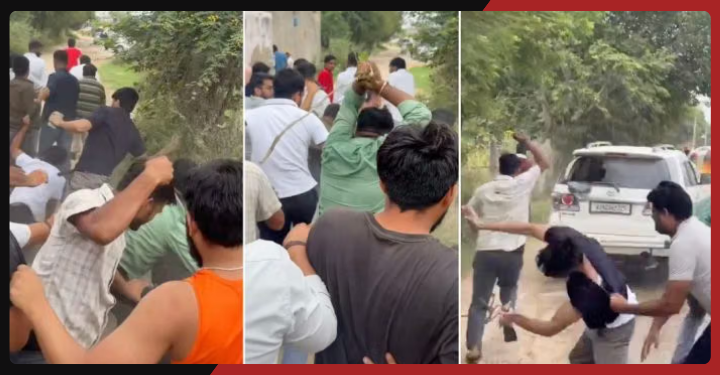
A political controversy erupted in Rajasthan on Friday after the Cockroach Janta Party alleged that its volunteers were attacked while attempting to inspect a government school in Jaipur district. The organisation blamed people it described as BJP workers for the confrontation, while local residents have disputed the allegations and defended their opposition to the CJP team’s visit.
The dispute began during the CJP’s “School Thik Karo” campaign, an initiative aimed at inspecting government schools and documenting infrastructure problems. CJP has said the campaign is focused on issues such as damaged buildings, inadequate toilets, lack of drinking water, electricity problems and shortages of teachers. The organisation says citizens have contacted it from several Rajasthan districts asking for school conditions to be examined.
CJP founder Abhijeet Dipke alleged that the organisation’s co-convenor Ashutosh Ranka and other volunteers were beaten during a school visit. He also claimed that vehicles were damaged and stones were thrown during the confrontation. Dipke accused BJP-linked individuals of carrying out the alleged attack and criticised the police response.
The claims have not been independently established, and local accounts provide a different explanation. Reports indicate that villagers gathered to oppose the CJP team’s presence. Some residents argued that they did not want a political organisation to turn a local school issue into a political campaign. They also reportedly pointed out that government funds had already been approved for development at the school.
The disagreement is particularly significant because the CJP’s campaign has already faced resistance from Rajasthan’s education authorities. Earlier this week, the Directorate of Secondary Education issued directions requiring outsiders to obtain permission before entering government-school premises. The order also restricted unauthorised photography, videography, interviews, audio recording and live streaming.
The government said the restrictions were necessary to protect children. The circular referred to constitutional privacy protections and school-safety guidelines. Authorities instructed school heads to ensure that images and information involving students were not collected or circulated in ways that could compromise their privacy, dignity or safety.
CJP has challenged the broader implications of the restrictions. The organisation argues that documenting public-school conditions is an important form of public accountability. It has continued to encourage people to report schools where basic facilities are allegedly missing.
The latest clash shows why the issue has become so sensitive. School infrastructure is a legitimate public concern, but schools are also spaces involving children, teachers and sensitive personal information. Any inspection involving outsiders must therefore balance transparency with safety and privacy.
The political dimension adds another layer. CJP has repeatedly criticised Rajasthan Education Minister Madan Dilawar over school infrastructure and challenged him to identify schools that represent the government’s best work. The minister and government authorities have not been shown to have directed the alleged violence, and accusations of political involvement should be distinguished from verified facts.
The incident could now lead to demands for a police inquiry. CJP has reportedly issued a 48-hour ultimatum demanding arrests and has threatened a statewide agitation if it believes adequate action is not taken.
For Rajasthan’s education system, the controversy carries a wider message. Disputes over school infrastructure should ideally be resolved through inspections, official reports, public hearings and administrative action rather than confrontation.
The condition of a government school can be independently verified. The amount of funding allocated can be checked. The status of construction can be examined. And allegations of assault can be investigated.
The challenge now is to move the debate away from political accusations and toward evidence.
The CJP says it wants to expose neglected schools. Local residents say they do not want political interference. The government says access restrictions are necessary to protect students. Between these positions lies the central question: how can Rajasthan improve government schools while ensuring that children’s safety and privacy remain protected?
That question is likely to remain at the centre of the controversy in the days ahead.
Journalist Details

- Jitendra Kumar is an Indian journalist and social activist from Hathras in Uttar Pradesh is known as the senior journalist and founder of Xpert Times Network Private Limited.
Latest entries
 Latest NewsSeptember 30, 2026Flydubai Emergency: Pilots Hospitalised After Flight Diverted From Tel Aviv to Saudi Arabia
 NewsSeptember 29, 2026Essar’s $18 Billion US Investment Links Minnesota Iron Ore Mine to Iowa Steel Mill
 Latest NewsSeptember 28, 2026Delhi to Double Parking Charges From November 1 as Winter Smog Measures Expand
 Latest NewsSeptember 27, 2026LPU Unrest Escalates From Campus Protest to Highway Blockade as Police Investigate Rape Allegation