
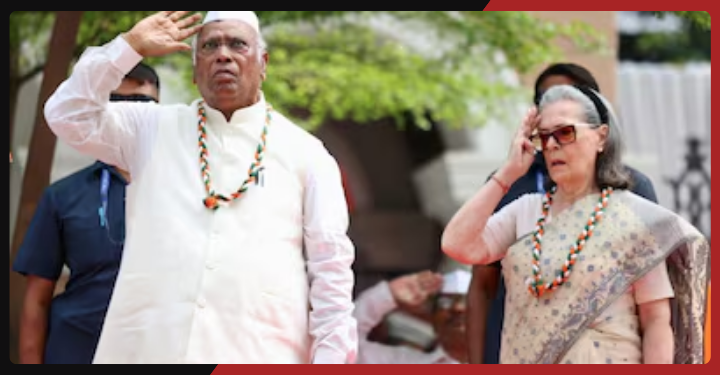
A fresh political confrontation between the BJP and Congress erupted on August 15, 2026, after a video from the Congress headquarters appeared to show Sonia Gandhi gesturing during the rendition of “Vande Mataram.” BJP leaders quickly alleged that the Congress leadership was attempting to stop the full version of the national song. Congress rejected the accusation, saying Sonia Gandhi’s gesture was related to arranging a chair for party president Mallikarjun Kharge.
The controversy unfolded during a year of heightened attention on “Vande Mataram.” The national song is marking its 150th anniversary in 2026, and the government has given it a prominent place in Independence Day celebrations. This year, “Vande Mataram” was sung from the Red Fort before the national anthem, marking a significant change in the traditional ceremonial sequence.
The Congress event in Delhi was attended by several senior party leaders. During the rendition of the song, footage showed Sonia Gandhi and Kharge making hand movements. The clip later spread rapidly online, accompanied by claims that they were asking the people conducting the programme to stop the performance.
BJP leaders seized on the footage and accused Congress of disrespecting a national symbol. Some demanded that the party explain the behaviour and apologise. BJP MP Sudhanshu Trivedi was among those who demanded an apology over what he described as disrespect to “Vande Mataram.”
The Congress response was immediate. Party leaders argued that the video was being interpreted incorrectly. They said that the full rendition of “Vande Mataram” had taken place and that there had been no attempt to stop it. Jairam Ramesh publicly dismissed the controversy and said there was no such issue.
Congress’s explanation focused on the circumstances surrounding Kharge. The party said Sonia Gandhi was asking for a chair for the Congress president, rather than signalling that the song should be stopped. This explanation offers an alternative interpretation of the exact same hand gesture that BJP leaders viewed differently.
This is where the controversy becomes difficult to resolve through the video alone. Political gestures are highly dependent on context. A hand movement may have several possible meanings, particularly when a public event involves multiple arrangements happening simultaneously.
The BJP has focused on the apparent timing of the gestures. Critics argue that they occurred while the national song was being performed and therefore appeared connected to the performance. Congress has focused on what happened around the leaders and says the gesture was connected to seating arrangements.
The controversy also needs to be viewed against the larger political debate surrounding “Vande Mataram.” The song has historically been associated with India’s freedom movement and has emotional significance for millions of Indians. It was formally recognised as the national song after Independence and given equal honour with the national anthem.
In 2026, the government has sought to reinforce that significance. The 150th anniversary has been used as an opportunity to promote the original and complete version of the song. Reports have also highlighted new official protocols surrounding its rendition.
The political controversy therefore goes beyond Sonia Gandhi personally. It touches upon a larger ideological argument over how national symbols should be treated and how political parties should conduct themselves during patriotic ceremonies.
For BJP supporters, the incident raises questions about whether Congress leaders show sufficient respect towards national symbols. For Congress supporters, the controversy is an example of political opponents taking an ordinary gesture out of context and turning it into a national controversy.
The viral nature of the footage has further intensified the dispute. Social media allows political videos to reach audiences far beyond the people who attended the original event. At the same time, short clips can remove important context and encourage viewers to form conclusions before seeing the entire event.
News reports have confirmed that the footage exists and that Sonia Gandhi made gestures during the rendition. They have also reported Congress’s explanation that the gesture related to a chair for Kharge.
What has not been independently established is that Sonia Gandhi intended to insult “Vande Mataram.” That remains an allegation made by political opponents and rejected by Congress.
The distinction matters because accusations involving national symbols carry considerable emotional and political weight. Calling something an insult implies intent, while a video showing a gesture does not necessarily establish intent.
The controversy also comes at a time when national symbols have become a particularly prominent part of public debate. The 2026 Independence Day celebrations have placed “Vande Mataram” in the national spotlight, especially with its historic performance at the Red Fort.
As the BJP and Congress continue to exchange accusations, the incident is likely to remain a major talking point across television debates and social media platforms. The BJP will probably continue to argue that the visuals speak for themselves, while Congress will continue to emphasise that the song was completed and that the gesture had a different purpose.
For the public, the most important point is to recognise the difference between what is visible and what is inferred. The footage has sparked the allegation; Congress’s explanation provides a competing account. Unless further evidence establishes the exact intention behind the gesture, the claim that Sonia Gandhi “insulted” the national song should be treated as a political allegation rather than a settled fact.
Journalist Details

Latest entries
 Latest NewsOctober 12, 2026Rahul Gandhi and Mallikarjun Kharge Face Setback Ahead of Planned Supreme Court March
 World NewsOctober 5, 2026Brazil Vote Tightens as Bolsonaro Falls Short of Decisive Victory
 Latest NewsOctober 1, 2026Two Lethal Injections Fail to Kill Tennessee Death Row Inmate Christa Pike
 Latest NewsSeptember 26, 2026Election Commission Says Differing Opinions Are Normal, Final Decisions Unanimous