
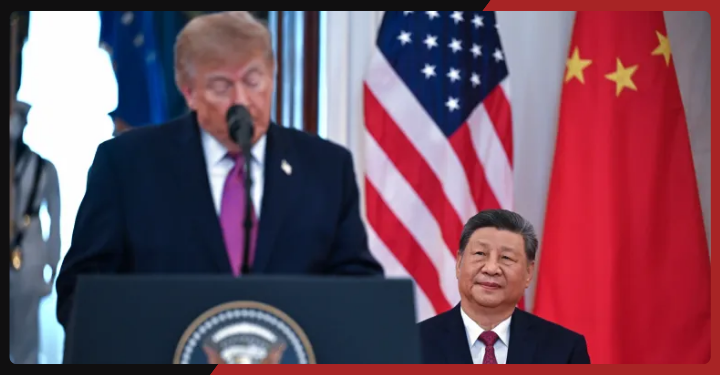
Artificial intelligence has become one of the most strategically important areas of competition between the United States and China, and it featured prominently in discussions surrounding the Washington summit.
Unlike traditional trade disputes, the AI competition involves technology, national security, economic development and military capabilities simultaneously. Both Washington and Beijing understand that leadership in advanced AI could influence the future of their economies and their geopolitical influence.
The United States has been particularly concerned about the transfer of advanced computing technology to China. American restrictions on certain semiconductors and advanced technology exports are designed partly around national-security concerns. Beijing has responded by increasing efforts to develop domestic technological capabilities and reduce dependence on foreign suppliers.
At the same time, both countries face risks associated with increasingly powerful AI systems. These risks are not limited to commercial competition. Governments are also concerned about cybersecurity, misinformation, autonomous systems and other potential consequences of advanced artificial intelligence.
This creates an unusual situation. Washington and Beijing are competing intensely while also having an incentive to communicate about some of the dangers associated with the technology.
Al Jazeera reported that the United States had proposed a mechanism under which Washington and Beijing could notify each other about AI incidents serious enough to pose national-security risks.
Such a mechanism would not eliminate competition. Instead, it could provide a communication channel designed to reduce the risk of misunderstandings.
The significance of AI in the summit also reflects the changing nature of US-China competition. Earlier disputes focused heavily on manufacturing, trade balances and market access. Today, advanced computing, semiconductor production, data infrastructure and AI models have become central strategic assets.
For Washington, maintaining leadership in AI requires continued investment in research, computing infrastructure and advanced chips. It also requires balancing technology development against national-security restrictions.
For Beijing, AI is closely connected to its broader strategy of technological self-reliance. Chinese companies and research institutions have been investing heavily in AI systems, chips and related infrastructure.
The competition therefore has global consequences.
Other countries are attempting to determine how they can participate in the AI economy without becoming overly dependent on either Washington or Beijing. Governments in Europe, Asia and other regions are developing their own technology policies, while companies are building international supply chains around AI-related products.
The US-China relationship could influence how these systems are developed and regulated globally.
If Washington and Beijing maintain communication, there may be opportunities to establish limited forms of cooperation around safety and crisis management. If the technology competition intensifies without communication, restrictions and counter-restrictions could create additional fragmentation in the global technology market.
The summit did not resolve this competition. Instead, it highlighted how AI has become one of the defining issues in the relationship.
The challenge for both governments is finding a way to protect national-security interests without completely eliminating technological and economic interaction.
For businesses, the key question is predictability. Companies need to know which technologies they can sell, where they can invest and how supply chains will be affected by government decisions.
For governments, the question is broader: how can technological leadership be pursued without creating a direct pathway toward strategic confrontation?
The Washington summit suggests that both countries recognise the importance of that question. Whether they can establish durable communication mechanisms around AI will be an important issue in the next phase of their relationship.
Journalist Details

- Jitendra Kumar is an Indian journalist and social activist from Hathras in Uttar Pradesh is known as the senior journalist and founder of Xpert Times Network Private Limited.
Latest entries
 EntertainmentOctober 25, 2026Udta Teer Day 2 Collection: Saturday Occupancy Rises as Evening Shows Perform Better
 Latest NewsOctober 20, 2026Bhagwat Says India Will Resist Regime Change as Political Debate Intensifies
 Latest NewsOctober 16, 2026CJP Leaders in Custody as Abhijeet Dipke Renews Demand for Gyanesh Kumar’s Resignation
 NewsOctober 14, 2026Delhi SIR Raises Questions Over Equal Voting Rights for Minority Communities