
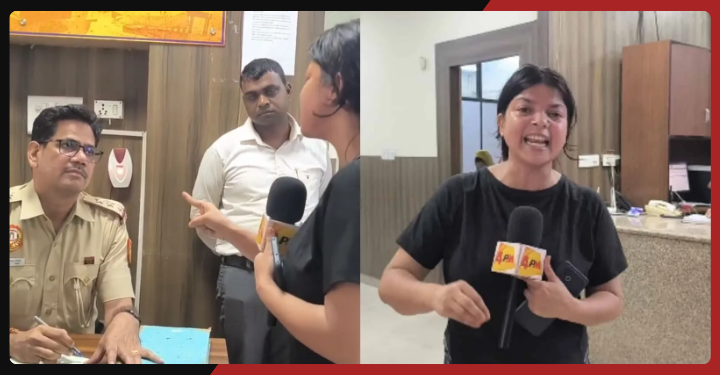
New Delhi: Two women journalists have alleged that an encounter with Delhi Police turned into a disturbing episode of physical violence and religious discrimination after their Muslim identity became known to officers.
Shaheen Khan and Nafisa Khan, associated with reporting for the digital news platform 4PM News Network, were covering an event in Saket attended by senior political leaders. What began as a reporting assignment, according to their account, ended with detention, alleged physical assault and accusations of religion-based targeting.
The journalists claimed that they were stopped by police personnel while covering the event and attempting to ask questions. They alleged that they were then taken to Saket Police Station.
According to Shaheen Khan’s account, the situation allegedly became more serious after police personnel learned about their identity. The journalists claimed that their names and surnames revealed that they were Muslims and that the alleged violence became harsher afterward.
The allegations have caused widespread concern because they involve two separate and serious issues: the alleged assault of journalists and the claim of discrimination based on religion.
India’s Constitution guarantees equality before the law, and allegations that a person’s religious identity influenced the conduct of law-enforcement personnel naturally demand serious scrutiny. At the same time, such allegations require a fair investigation based on evidence.
Videos shared online showed the journalists with apparent bruises and injury marks. These visuals intensified public reaction and led several media organisations to demand accountability.
Journalist associations have argued that the matter should be investigated independently and fairly. They have called for action against any officials found responsible if the allegations are established through evidence.
Delhi Police, however, has rejected the journalists’ version of events. Police officials have described the allegations as factually incorrect and misleading. According to the police, the women allegedly interfered with movement on a VVIP security route and did not comply with directions given by officers.
The police have denied that the journalists were assaulted because of their questions or because of their Muslim identity. This denial has created two sharply different versions of the same incident.
For the journalists, the incident represents an alleged attack on their dignity, professional freedom and religious identity. For Delhi Police, the matter is connected to security management and alleged obstruction.
The truth may depend on evidence that can independently verify the sequence of events. CCTV recordings from the venue and police station, mobile phone videos, witness statements and official records could all help investigators establish what happened.
The case has also highlighted the increasing importance of digital journalism in India. Independent journalists and online news platforms frequently report from locations where traditional media organisations may not have large teams or institutional protection.
Many independent reporters rely on mobile phones and small production teams. Their ability to report freely can therefore be particularly vulnerable when disputes arise with authorities.
The religious discrimination allegation has added another sensitive dimension to the case. Civil society groups and journalist organisations have said that the issue cannot simply be treated as an ordinary disagreement between reporters and police.
A transparent investigation would help establish whether the journalists were subjected to unlawful treatment and whether religious identity played any role in the alleged conduct.
The controversy has now become a national discussion about equality, policing and media freedom. Whatever the final findings may be, the case demonstrates why complaints involving police conduct must be investigated openly and credibly.
For Shaheen Khan and Nafisa Khan, their allegations have become a public demand for answers. For Delhi Police, the challenge will be to respond to the controversy in a way that builds public confidence.
The final outcome will depend on evidence, investigation and accountability—not social media claims alone.
Journalist Details

- Jitendra Kumar is an Indian journalist and social activist from Hathras in Uttar Pradesh is known as the senior journalist and founder of Xpert Times Network Private Limited.
Latest entries
 Crime NewsSeptember 4, 2026‘Targeted Because of Our Names’: Journalists’ Allegations Trigger Religious Discrimination Row
 NewsSeptember 1, 2026With Pakistan PM Present, Modi Calls for Complete Dismantling of Terror Ecosystem
 Crime NewsAugust 31, 2026From Gym Shooting to Police Encounter: The Timeline of the Ankit Balyan Murder Investigation
 Latest NewsAugust 27, 2026Ganga Barrage Tragedy: Instructor and Trainee Pilot Killed in Kanpur Crash