
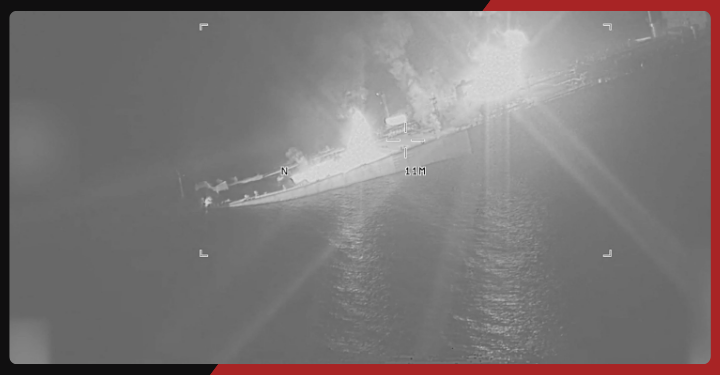
The Strait of Hormuz has emerged as the central flashpoint in the latest escalation between the United States and Iran, with both sides increasing pressure on military and commercial shipping in the strategically vital waterway.
The latest crisis intensified after U.S. forces destroyed five Iranian oil tankers. Washington said the action followed Iranian missile attacks against a U.S. Navy warship.
Iran subsequently claimed attacks against American vessels and oil tankers near the Strait. Iranian Revolutionary Guard forces said they had targeted ships attempting to cross what Tehran described as an unsafe or prohibited zone.
The Strait of Hormuz is particularly important because of its role in international energy markets. Oil and gas shipments from several Gulf producers pass through the waterway, making any military disruption potentially damaging to the global economy.
The latest escalation has already affected crude prices. Brent oil moved above $100 per barrel as traders reacted to growing concerns about supply disruptions.
For Iran, control or disruption of maritime traffic can provide a powerful source of leverage. Tehran has long understood the strategic importance of the waterway, while the United States maintains substantial naval capabilities in the region.
Washington has sought to keep commercial shipping routes open and has used naval forces to protect maritime movement. Iran, meanwhile, has threatened ships that it says violate its restrictions.
The latest confrontation therefore involves more than individual military vessels. It directly affects commercial shipping companies, oil traders, insurance companies and governments around the world.
The U.S. destruction of five Iranian oil carriers also demonstrates how economic warfare and conventional military operations are increasingly overlapping. American officials say the vessels were associated with Iranian oil networks that help generate revenue for the Revolutionary Guard and allied groups.
Iran’s response has been to increase the risks faced by U.S. and commercial vessels in the region. The Revolutionary Guard has claimed attacks against multiple ships, although individual battlefield claims can be difficult to independently verify during an active conflict.
The danger is that the maritime confrontation could become self-sustaining. If Iran attacks an American warship, Washington could respond against Iranian vessels or infrastructure. If the United States strikes another tanker, Iran could retaliate against American military assets or commercial shipping.
Such a cycle would make the Strait increasingly dangerous for international vessels.
The economic consequences could be severe. Higher oil prices can increase transportation and manufacturing costs, contribute to inflation and place additional pressure on economies that rely heavily on imported energy.
Asian economies could be particularly exposed because many major energy importers depend on supplies moving through the Gulf region.
The latest developments have also raised concerns about whether the conflict could involve other regional actors. Iran-aligned Houthi forces have launched attacks against Saudi targets, adding another layer to the growing regional instability.
The United States and its allies now face the challenge of keeping maritime trade open without triggering a larger war.
For Iran, the challenge is equally complex. Tehran wants to demonstrate that American pressure has consequences while avoiding a response so severe that it provokes overwhelming U.S. military action.
The Strait of Hormuz therefore remains the critical pressure point. Any further military incident there could have consequences far beyond the Middle East.
Journalist Details

- Jitendra Kumar is an Indian journalist and social activist from Hathras in Uttar Pradesh is known as the senior journalist and founder of Xpert Times Network Private Limited.
Latest entries
 Latest NewsOctober 20, 2026Bhagwat Says India Will Resist Regime Change as Political Debate Intensifies
 Latest NewsOctober 16, 2026CJP Leaders in Custody as Abhijeet Dipke Renews Demand for Gyanesh Kumar’s Resignation
 NewsOctober 14, 2026Delhi SIR Raises Questions Over Equal Voting Rights for Minority Communities
 Crime NewsOctober 13, 2026Hyderabad Police Investigate Suspicious Death of 29-Year-Old Software Engineer