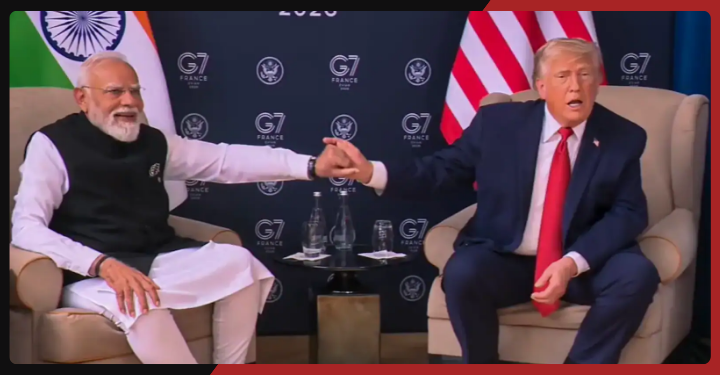
President Donald Trump’s renewed push for the SAVE America Act has gained fresh momentum after he cited India’s election system as an example of how voter identification can be used on a massive scale.
Trump has repeatedly argued that American elections need stronger safeguards, and his latest remarks place particular emphasis on photo identification and citizenship verification.
In a Truth Social post, Trump referred to an alleged recent conversation involving India’s Chief Election Commissioner Gyanesh Kumar. According to Trump, Kumar questioned how American elections could be held without a mandatory valid photo identification document. Trump used the observation to reinforce his demand for passage of the SAVE America Act.
The legislation is designed to establish stricter federal requirements for voter registration and voting eligibility. Among its central provisions is a requirement for documentary proof of US citizenship when registering to vote in federal elections.
The White House strongly supports the measure and argues that citizenship verification is a basic requirement for election security. Its official explanation directly cites India and Brazil as examples of countries that connect voter identification with broader identity systems.
Trump’s reference to India is strategically important because of the country’s experience managing elections involving hundreds of millions of people.
During India’s 2024 Lok Sabha election, hundreds of millions of citizens participated across seven phases. Voters were identified using election-related documents, with the Elector Photo Identity Card, commonly known as EPIC or voter ID, serving as a major identification document.
Trump cited approximately 646 million voters and said less than one per cent voted by mail. He presented these figures as evidence that a large democratic electorate can operate with strong voter identification requirements.
The American system, however, operates differently.
Election administration in the United States is largely decentralised. State governments and local election authorities have significant responsibilities concerning voter registration, polling procedures and identification requirements.
Some states require photo identification at polling stations, while others permit alternative forms of verification or use different procedures.
Trump wants a more uniform federal approach.
Supporters of his proposal say national standards would prevent confusion and strengthen election integrity. They argue that voters should be able to establish both their identity and citizenship before participating in federal elections.
Critics have challenged that approach, arguing that stricter documentation requirements could disproportionately affect eligible voters who do not have easily accessible government documents. They also point to the need for safeguards that allow citizens to vote even when they face difficulties obtaining identification.
The political battle therefore extends beyond the technical question of voter cards. It is fundamentally about access to elections, federal authority and public confidence in democratic institutions.
Trump’s argument that India provides a useful example is likely to appeal to voters who support stronger election safeguards. But opponents are expected to argue that the American constitutional system cannot simply import another country’s election model.
The debate also comes at a politically important moment. The United States is preparing for the 2026 midterm elections, making election rules a major issue for both parties.
Trump’s latest remarks show that India’s electoral system has become part of this domestic American debate.
The episode is also significant diplomatically. India is being discussed not merely as a strategic partner or economic power, but as an example of election administration.
Whether the SAVE America Act becomes law remains a matter for Congress. But Trump’s decision to invoke India demonstrates how strongly his administration is trying to make voter identification a central part of the American election agenda.
Journalist Details


- Jitendra Kumar is an Indian journalist and social activist from Hathras in Uttar Pradesh is known as the senior journalist and founder of Xpert Times Network Private Limited.
Latest entries