
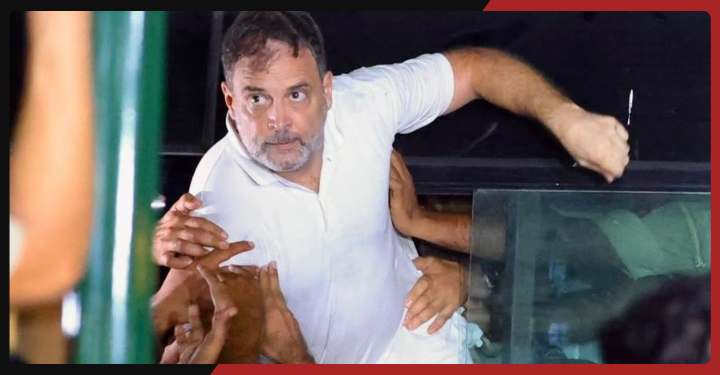
Congress leader Rahul Gandhi and party leader Priyanka Gandhi Vadra were among several opposition leaders detained by Delhi Police on October 6 after a protest demanding the resignation of Chief Election Commissioner Gyanesh Kumar turned into a prolonged standoff in the national capital.
The demonstration was organised by opposition parties as part of their continuing campaign over electoral-roll revisions and alleged irregularities in the voter-list process. Opposition leaders have repeatedly questioned the Election Commission’s handling of the Special Intensive Revision (SIR) and have demanded greater transparency from the poll body. The Election Commission has rejected the allegations and defended the electoral-roll exercise.
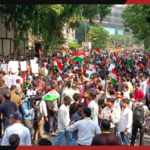
The protest began when opposition MPs attempted to march towards the Election Commission headquarters. Rahul Gandhi, who has been leading the opposition’s campaign on electoral issues, joined the march along with several INDIA bloc leaders. Police had placed barricades along the route, preventing the lawmakers from proceeding towards the poll panel’s office.
The presence of heavy police deployment led to a tense situation as opposition leaders tried to cross the barricades. Gandhi was seen standing on a barricade while holding the national flag. Opposition MPs raised slogans and demanded that the Election Commission meet their delegation.
The disagreement subsequently moved to the area around Akashvani Bhavan. Rahul Gandhi and Priyanka Gandhi Vadra, along with other opposition MPs, staged a sit-in after the march was stopped. Their demand was that a delegation should be permitted to meet the Election Commission and present its concerns directly.
Rahul Gandhi argued that opposition MPs had a democratic right to raise questions about the electoral process. He maintained that the protest was intended to defend the rights of voters and seek answers from the constitutional institution responsible for conducting elections.
The Congress has made electoral transparency a major political issue, accusing the Election Commission of failing to provide satisfactory answers to questions raised by opposition parties. Gandhi and other opposition leaders have used the term “vote chori” while alleging problems with voter lists and the electoral process. The Election Commission has rejected such accusations.
The poll body later issued its own explanation regarding the proposed meeting. According to the Election Commission, political parties can request appointments with the Commission and such meetings are ordinarily held at the Commission’s office. The Commission said that it was informed that Gandhi and other leaders wanted to meet at Parliament House Annexe.
The Election Commission said it offered an alternative arrangement in which a senior official would receive the opposition’s memorandum. However, the opposition delegation did not accept that proposal. The Commission maintained that it had not refused to hear the concerns of political parties but had followed established procedures for meetings.
The BJP, meanwhile, criticised the opposition demonstration and accused Congress and its allies of creating unnecessary confrontation with a constitutional institution. BJP leaders defended the Election Commission and rejected the allegations of electoral manipulation. The ruling party has argued that the revision of electoral rolls is intended to ensure that voter lists remain accurate and contain eligible voters.
The opposition has taken a sharply different position. Congress leaders say the Election Commission must provide clear answers about how voter lists are being revised and why certain names may be removed or challenged. They have also questioned whether the process could disproportionately affect sections of the electorate.
The protest continued for several hours despite repeated efforts by police to clear the area. As the standoff continued, Delhi Police eventually detained Rahul Gandhi, Priyanka Gandhi Vadra and other opposition leaders. They were taken away from the protest site and later released.
The detention quickly became another political flashpoint. Congress leaders criticised the police action and said the government was attempting to suppress legitimate democratic protest. The BJP and authorities maintained that police intervention was necessary to manage the gathering and maintain public order.
The episode highlights the increasingly confrontational relationship between the opposition and election authorities. While the opposition views the electoral-roll dispute as a question of democratic accountability, the Election Commission maintains that its procedures are designed to protect the integrity of the voter list.
Rahul Gandhi’s detention has also given the Congress another opportunity to intensify its campaign on electoral issues. The party is expected to continue pressing for answers from the Election Commission and demanding accountability from Chief Election Commissioner Gyanesh Kumar.
The October 6 protest therefore ended without resolving the fundamental disagreement between the two sides. The opposition continues to seek greater transparency and political accountability, while the Election Commission maintains that its electoral-roll procedures are legitimate and that concerns should be addressed through established institutional mechanisms. The dispute is likely to remain an important issue in India’s political debate in the coming weeks.
Journalist Details

- Jitendra Kumar is an Indian journalist and social activist from Hathras in Uttar Pradesh is known as the senior journalist and founder of Xpert Times Network Private Limited.
Latest entries
 NewsOctober 7, 2026Rahul Gandhi, Priyanka Gandhi Among Opposition Leaders Detained After Delhi Protest
 SportsOctober 6, 2026Smriti Mandhana Emerges as Leading Contender as India Searches for Harmanpreet Kaur’s Successor
 World NewsOctober 4, 2026Yemen Escalates Military Campaign Against Houthis, Army Reports 700 Deaths
 Latest NewsOctober 3, 2026From CEC Row to Modi Demand: How Dipke’s Protest Has Expanded