
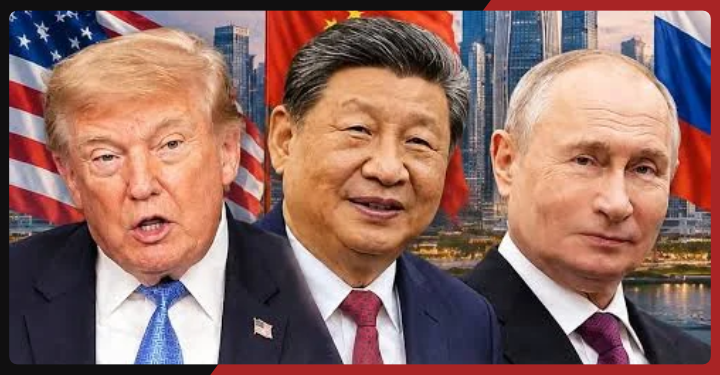
Nuclear security is expected to become one of the most important subjects when US President Donald Trump, Chinese President Xi Jinping and Russian President Vladimir Putin meet in China next week. The unprecedented three-way gathering is scheduled for November 19 in Shenzhen, alongside the Asia-Pacific Economic Cooperation summit.
The meeting comes at a particularly sensitive time for international nuclear security. The New Strategic Arms Reduction Treaty, known as New START, expired in February 2026, ending the last major bilateral agreement limiting the strategic nuclear arsenals of the United States and Russia.
For decades, arms-control agreements have played an important role in preventing an uncontrolled expansion of nuclear weapons. The expiration of New START has created uncertainty about the future of strategic weapons restrictions between Washington and Moscow.
Trump has indicated that he wants a new agreement that is more modern and comprehensive. Unlike previous arrangements, his proposed framework would also involve China.
The American president believes that China should become part of future nuclear negotiations because of its expanding military capabilities and growing international influence. However, Beijing has not demonstrated much enthusiasm for joining a three-country arms-control arrangement.
China’s position is based partly on the difference in nuclear capabilities. American and Russian nuclear stockpiles are significantly larger than China’s. Beijing has argued that it would be unfair to expect all three countries to accept identical restrictions when their arsenals are at different levels.
According to estimates cited in recent reporting, Russia and the United States each possess more than 5,000 nuclear warheads, while China’s arsenal is estimated at more than 600. These differences highlight the challenges involved in negotiating a common framework.
The planned meeting could provide the three leaders with an opportunity to exchange views on nuclear stability, strategic competition and the possibility of future negotiations.
However, expectations of an immediate agreement remain limited. A senior American administration official has indicated that the meeting should be considered the beginning of a conversation rather than an occasion for announcing a final deal.
The three countries also face broader geopolitical disagreements. Washington and Beijing have competing interests involving trade, technology and military influence in the Indo-Pacific region. Meanwhile, relations between Washington and Moscow remain affected by the war in Ukraine and disagreements over international security.
Putin could use the meeting to encourage a broader discussion about nuclear relations between the three countries. Moscow has previously supported extending the previous arms-control arrangement, while Trump has argued that any replacement should include China.
Xi will face the challenge of balancing China’s strategic interests with the international pressure to participate in discussions about nuclear security.
The meeting is also expected to address the war involving Iran, another issue with implications for international stability.
Although the summit may not immediately resolve the nuclear arms-control problem, it could establish a diplomatic channel for future discussions. Any progress would require technical negotiations, verification arrangements and political commitments from all three governments.
The world will therefore be watching closely to determine whether the historic gathering can create a foundation for renewed nuclear diplomacy or whether disagreements will prevent meaningful progress.
Journalist Details

Latest entries
 World NewsNovember 14, 2026Nuclear Arms Control Expected to Dominate Trump-Xi-Putin Summit
 Latest NewsNovember 2, 2026Delhi’s Winter Pollution Returns: AQI Crosses 300 as GRAP-II Triggers Emergency Action
 World NewsOctober 22, 2026Eight Injured as Attack Damages Saudi Arabia’s King Fahd International Airport
 Latest NewsOctober 12, 2026Rahul Gandhi and Mallikarjun Kharge Face Setback Ahead of Planned Supreme Court March