
[ad_1]
French connection
Titled To France-In India, the book release (that happened on April 26 at Alliance Francaise de Delhi) also marks the beginning of a month-long exhibition showcasing some of the pictures taken by Raghu Rai and Emmanuel Lenain.
France holds a special place in Raghu’s heart and he refers to it as his ‘eternal muse’. His love for the country is evident when he says, “France is like a pilgrimage for me—the camera was invented in France at the academy of fine arts, also known as Academie des Beaux-Arts, Paris.” Interestingly enough, in 2019, he got a call from the very same academy telling him that he was one of 16 photographers from all over the world shortlisted for an award. The very next day he got a call telling him that he’d won! That’s how he became the First Laureate Photographer of the First Edition of the Academie des Beaux-Arts Photography Award –William Klein.
The award was handed over to him at a ceremony which he attended with his wife Gurmeet and daughter Avani. In fact, in the book, the section on France ends with a picture of Raghu receiving the award; the picture was taken by Avani.
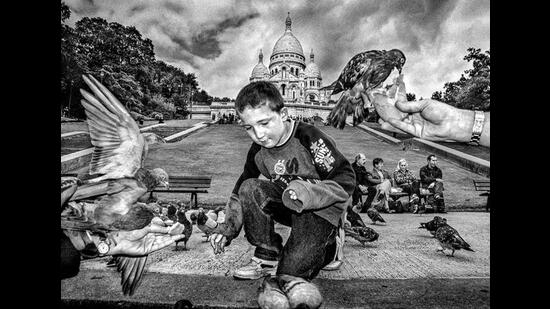
But Raghu has another strong connection to France: his unique friendship with one of the world’s greatest photographers, Henry Cartier-Bresson, who had invited Raghu Rai to join Magnum Photos, a rare honour in those days. “Right from my very first exhibition in Paris in 1971, France has always appreciated my work immensely, and I have always seen that good photography and photographers are always respected there. In 1998, a French magazine, Le Figaro had invited six photographers from across the world to capture the Spirit of Paris. I was one of them and was assigned to photograph Montmartare, which truly inspired me. I have always had a special connection with France and that’s why it’s like a pilgrimage for me,” says Raghu whose pictures of France, spread over 100 pages, are a beautiful mix of earthscapes, Montmartre, events, streets of vibrancy, and the various facets of human emotions.
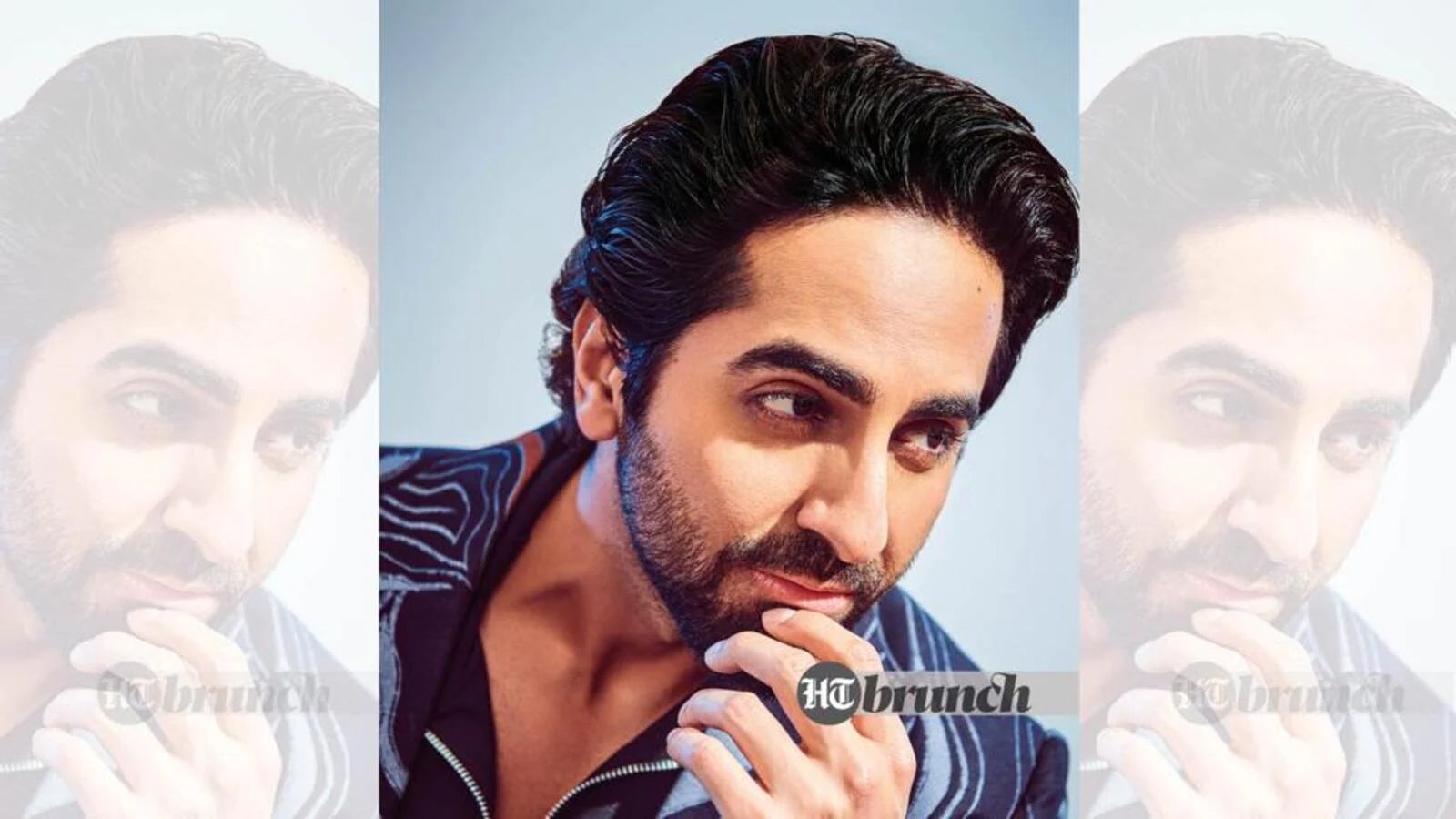
Each role that Ayushmann chooses carries with it a certain implication. By choosing ‘risky’ subjects like sperm donation in his first movie (Vicky Donor, 2011), tackling erectile dysfunction (Shubh Mangal Saavdhan, 2017), premature balding (Bala, 2019) or the more hard-hitting topic of casteism (Article 15, 2019), the actor successfully managed to carve out a sub-genre for himself within Bollywood, one that he has been ruling without any real competition.
“Every artist should have some empathy,” he declares, crediting his background in street theatre for igniting his passion for picking message-driven films camouflaged with a heavy dose of entertainment. “I firmly believe that my films are just an extension of my theatre personality. As an artist, you should have a certain social responsibility, and I’d like to take that forward,” he says. “Frankly speaking, films are meant to entertain you. And the social message cannot really overpower the entertainment quotient. The message should be the underlying change or statement. I try to achieve that in every film.”
His die-hard fans pack theatres to see every movie he makes, which means there’s now a certain expectation the audience has of Ayushmann. And with expectations come pressure, something he acknowledges.
Picture perfect
Filled with love, respect, reverence and the magic of Raghu Rai’s expertise, the book is divided into four sections, showcasing the filmmaker in every possible mood, surrounding and emotion. He has as many as 70 pictures of the filmmaker, shot over a period of just two days, but capturing a lifetime of emotions.
Minimalist mindset
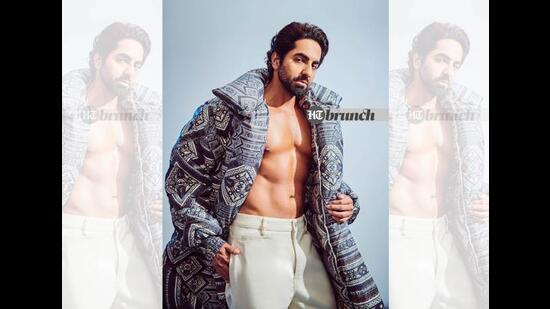
Ayushmann is definitely more ‘normal’ or relatable than most stars. “I’m a minimalist, even as a person. That’s why my films resonate with my personality,” he says, explaining,” I still wear those four denims and six favourite T-shirts, you know? I repeat my clothes. I love shoes, but I don’t have a big collection. My passions are different. I have more books, or travel more, or go for long drives with my friends, or jam with them, or invest more in musical instruments… so it’s just a more simplistic way of living.”
Surely a small-town boy who becomes a successful Bollywood star has some vices, some guilty pleasures that he indulges in every now and again? He takes a beat before answering, “I love every kind of desi sweet; Bengali, Punjabi… I love to eat sweets, ya,” revealing yet again that truly rare star quality: relatability.
He echoes that when he admits—and appreciates—that his journey to the top isn’t something you see every day. “Coming from a small city and making it big, it’s a miracle. For a person like me, who’s unconventional, who’s made unconventional choices, at this stage, I think it’s an absolute miracle,” he says.
“It was like a dream come true. I was shooting everything and was scared to miss even a single frame. Even though I felt nervous in his presence, the sensitivity in his eyes, the dignity and affection that he has is reflected in most of his portraits, and is unforgettable,” recalls Raghu.
Unfortunately, after he returned from Kolkata, Raghu realised that many of the photographs that he took of Satyajit Ray in his house were underexposed and underdeveloped, and couldn’t be used at that time. But, thanks to digital technology, the same unused pictures were finally brought to life and the same pictures were used to produce this book.
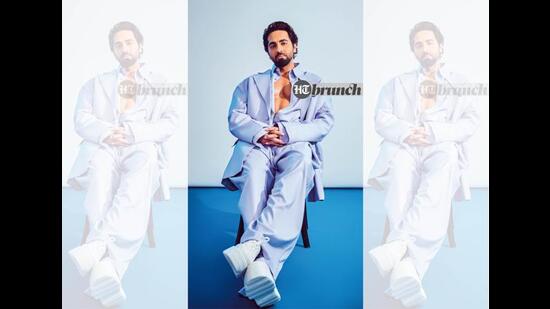
“If you’re making films that promote certain messages and aspire to social change, but at the ground level if you aren’t doing anything, it becomes redundant,” Ayushmann says. “I’m a UNICEF celebrity advocate and I’ve quite active on that platform. Being part of UNICEF, I get enlightened about a lot of things, and I use my influence to make certain changes in society.” In fact, in 2020, Ayushmann was appointed as UNICEF India’s Celebrity Advocate for their global campaign EVAC (Ending Violence Against Children).
The actor, who has two children with his wife Tahira Kashyap (also an HT Brunch cover star) extends his simple way of living to how they raise their sons.
“We don’t let our children watch my movies,” he reveals, “because we don’t want them to grow up overwhelmed thinking, ‘my father is a star.’ We want to give them a normal childhood without making them realise that they have a certain privilege.”
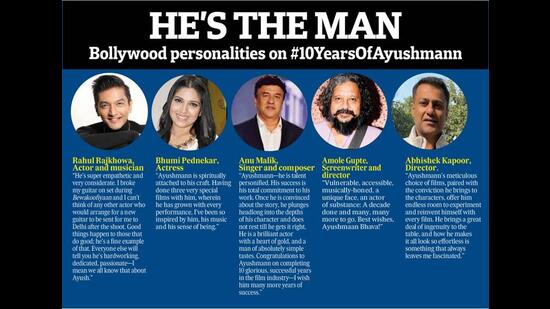
Plan Z
It’s no secret that Bollywood is an unforgiving industry, with an unforgiving audience. For an actor who has to prove himself repeatedly, Ayushmann has no Plan B. What he does have are well thought-out Plans B, C and Z; having faced failure before, he’s now someone who likes to be prepared. “When my films weren’t working, I formed a band,” he says. “I started singing at college fests, at weddings, at family functions… so I have a lot of plans. There’s no dearth of plans in my life because I’ve been on that journey.”
He readily agrees with the suggestion that he is a very, very practical person, and has a no-bullshit way of looking at life, without any of the concessions one normally associates with being in a creative field. “I think as an artist you should be financially secure,” he states. “Because, if there’s no financial security, for an artist I think it’s difficult to be creative. I’m not from that school of thought that says only if you’ve suffered darkness can you create something. I think that’s a very, very screwed-up way of looking at life.”
After being in the industry for 10 years now, what comes next? Does he still feel challenged? “Now the challenge is how to do things differently, maybe discover more genres for myself,” says Ayushmann, whose two upcoming releases Anek, a socio-political thriller set in Northeast India, and Action Hero, are both genres he hasn’t explored before.

He’s yet to play an anti-hero in any of his films though, something he’s definitely open to. True to form though, he adds the caveat, ”It’s just that the messaging should be correct. I’m okay being negative, but the messaging of the film should be right. I’ll never do a role that makes a hero out of a villain.”
What comes next?
Apni manzil pe pahunchna bhi, khade rahna bhi, kitna mushkil hai, bade ho ke bade rahne bhi (How difficult it is to reach your destination, to even stand there, to achieve something and remain an achiever),” quotes Ayushmann when asked about what the next decade has in store for him.”I’m too practical to plan for the next 10 years or five years,” he says. “I plan one day at a time. But I will say that in 10 years, I’ll be more than just an actor. I’ll probably produce in the future, maybe write a script or direct—something related to this field.”
He does, however, know which directors he’d like to work with next, for the time being. “I would love to work with Raju Hirani! And Rohit Shetty and Zoya Akhtar,” he exclaims, leaving one in little doubt that he’ll make it happen.
Follow @modwel on Instagram and @UrveeM on Twitter
From HT Brunch, April 30, 2022
Follow us on twitter.com/HTBrunch
Connect with us on facebook.com/hindustantimesbrunch
[ad_2]
Source link
Journalist Details

Latest entries
 Latest NewsMarch 24, 2026Planning to Cancel Your Train Ticket? New Railways Rules Explained
 Brand StoriesMarch 24, 2026Shivam Muchhal: The Driving Force Behind SM Entertainment’s Rise as India’s Event Powerhouse
 Latest NewsMarch 23, 2026Sattankulam Case Verdict: Court Convicts Nine Police Personnel for Custodial Torture and Death
 Latest NewsMarch 19, 2026Public Outrage in Roopnagar: Negligence by Authorities or Public Mistake?