
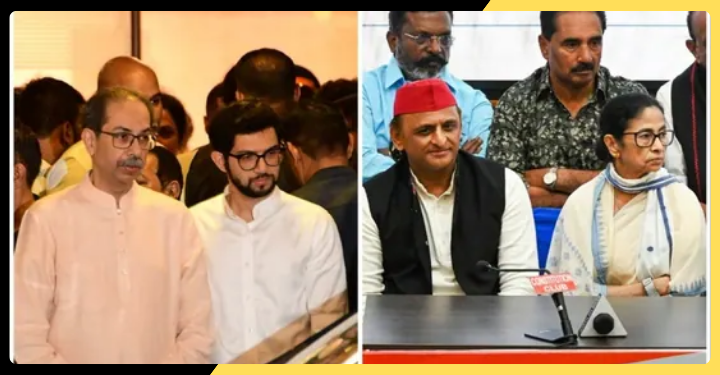
The internal challenges confronting the Trinamool Congress (TMC) and Shiv Sena (UBT) have once again highlighted the importance of political stability in determining parliamentary outcomes. While elections establish the broad balance of power, the day-to-day functioning of Parliament often depends on party discipline, coalition management, and the ability of leaderships to keep lawmakers united. Any signs of unrest within major opposition parties can have consequences that extend far beyond individual organizations.
The recent discussions surrounding dissent and dissatisfaction within sections of TMC and Shiv Sena (UBT) have attracted attention because both parties play important roles in the opposition ecosystem. Their parliamentary presence contributes to the broader effort to challenge the ruling National Democratic Alliance (NDA) on legislative and political issues. If internal tensions intensify, they could reshape parliamentary equations in ways that ultimately benefit the government.
Parliamentary politics is fundamentally a numbers game. Every vote matters, particularly on contentious legislation, constitutional amendments, and key policy debates. Opposition parties often rely on coordinated action to maximize their influence. When a party experiences internal divisions, its ability to participate effectively in collective opposition strategies can diminish.
For TMC, maintaining unity has traditionally been one of its strengths. The party has built a reputation for centralized leadership and disciplined organization. However, as political ambitions grow and new leaders seek greater influence, managing internal expectations becomes increasingly complex. Even limited dissent can create uncertainty about voting patterns and strategic coordination.
Shiv Sena (UBT) faces a different challenge. The party continues to recover from the political split that significantly altered Maharashtra’s political landscape. While the leadership has sought to consolidate support and rebuild organizational structures, maintaining cohesion remains a critical objective. Any additional signs of dissatisfaction could further complicate these efforts.
The impact of such developments is often felt most strongly in Parliament. Opposition parties depend on coordinated floor management to challenge government proposals, demand accountability, and influence public debate. If members become less engaged or begin pursuing independent political calculations, opposition effectiveness can suffer.
The Lok Sabha may not witness dramatic shifts immediately because the NDA already enjoys substantial numerical strength. However, a fragmented opposition can make legislative proceedings smoother for the government. Debates become less coordinated, amendment strategies lose momentum, and issue-based campaigns become harder to sustain.
The Rajya Sabha presents a more nuanced picture. Since governments do not always command overwhelming majorities in the upper house, opposition unity becomes particularly important. Small changes in attendance, abstentions, or voting behavior can significantly affect outcomes. If opposition parties struggle to maintain internal discipline, the NDA could gain greater flexibility in advancing its legislative agenda.
Another factor is political perception. Stable and disciplined parties often project confidence and credibility. Conversely, reports of internal rebellions can create an impression of uncertainty. Such perceptions influence not only parliamentary proceedings but also public opinion and future alliance-building efforts.
The broader opposition alliance framework could also face challenges if individual parties become preoccupied with internal disputes. Coordinating strategy across multiple parties requires trust, consistency, and strong leadership. Internal turmoil can divert attention away from common objectives and reduce the effectiveness of collective action.
Political analysts often point out that modern parliamentary contests are not decided solely by electoral victories. Organizational cohesion, leadership authority, and strategic discipline are equally important. Parties that successfully manage internal differences are generally better positioned to influence national politics.
Looking ahead, much will depend on how TMC and Shiv Sena (UBT) address concerns within their ranks. Effective communication, inclusive decision-making, and organizational reforms could help contain dissatisfaction. However, if tensions continue to grow, parliamentary equations may gradually shift in favor of the NDA.
Ultimately, the current developments serve as a reminder that parliamentary strength is not merely a matter of numbers on paper. It also depends on unity, coordination, and the ability of parties to keep their members aligned behind a common political purpose. In that respect, the challenges facing TMC and Shiv Sena (UBT) could have implications that extend well beyond their own party boundaries.
Journalist Details

- Jitendra Kumar is an Indian journalist and social activist from Hathras in Uttar Pradesh is known as the senior journalist and founder of Xpert Times Network Private Limited.
Latest entries
 NewsOctober 14, 2026Delhi SIR Raises Questions Over Equal Voting Rights for Minority Communities
 Crime NewsOctober 13, 2026Hyderabad Police Investigate Suspicious Death of 29-Year-Old Software Engineer
 World NewsOctober 11, 2026Hydropower Project and Bridges Damaged as Nepal Floodwaters Surge
 Latest NewsOctober 10, 2026Delhi on High Alert as CJP Protest Draws Attention to Electoral Roll Revision Controversy