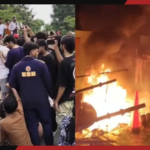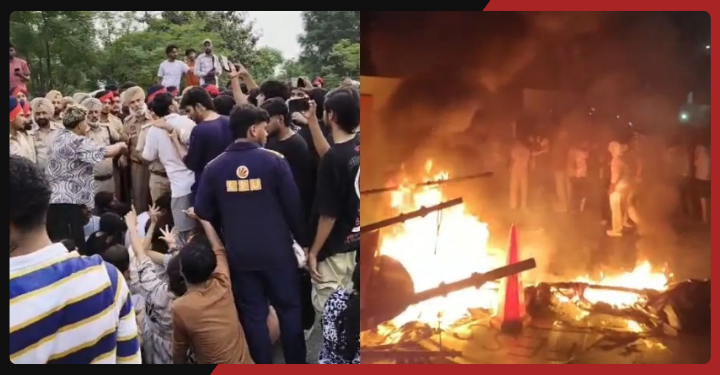
Lovely Professional University in Phagwara witnessed intense student unrest in the early hours of September 27 after an alleged rape incident became the subject of rapidly spreading social-media messages. The protest escalated into campus vandalism and a highway blockade before police moved in to restore order.
The controversy began with claims circulating among students about a female student allegedly being assaulted. The precise circumstances described in different online messages varied. Some reports referred to an outsider or construction worker, while other messages added claims about the student’s death. Police and university authorities did not initially confirm those claims.
Students began gathering at the university during the night. According to reports, the first major gathering took place near the girls’ hostel around 2 a.m. The subject of the protest was the safety of female students and the alleged handling of the incident by university authorities.
The gathering soon became increasingly tense. Students damaged windows, broke other property and threw objects inside the campus. Some reports also described fires involving parts of buildings or objects.
The escalation placed pressure on university security personnel, who were reportedly unable to contain the crowd. As the protest grew, students moved toward the university gate and then onto the road outside the campus.
The highway blockade became one of the most visible consequences of the protest. Students obstructed traffic on the Jalandhar-Phagwara route, with reports also describing disruption on the Chandigarh-Amritsar National Highway. Traffic congestion followed, and police personnel were deployed to manage the situation.
Kapurthala SSP Gaurav Toora reached the area along with other officers. Early police comments indicated that officials had not received confirmation of the alleged rape when they arrived. The SSP said rumours had contributed to the gathering and that police were communicating with students.
However, later developments added another dimension. Reporting from the scene said police had received a statement from a student and registered a case. DIG Jalandhar Range Naveen Singla was quoted as saying investigators would conduct technical examination of the case, including forensic material, CCTV footage and phone analysis.
These developments demonstrate why early reports of fast-moving incidents can change as investigators obtain information. An allegation circulating online is not the same as a police finding, and a police investigation does not itself establish guilt.
The university administration sought to prevent further escalation by asking students not to participate in disruptive activities. It urged students to remain in their accommodation and cooperate with authorities.
Students, meanwhile, reportedly raised questions about hostel management and safety arrangements. Later reports said representatives were expected to meet university officials to discuss these concerns.
The protests also occurred against the background of another student controversy at a private university in Punjab. A day earlier, Chitkara University in Patiala had witnessed protests after social-media claims about students and a supposed incident on campus spread online. University officials denied the claims circulating at that institution.
The sequence of events has increased attention on the role of social media in campus emergencies. Universities are often communities where information moves rapidly through student groups, messaging applications and online platforms. When information concerns personal safety, emotions can escalate particularly quickly.
The LPU case also raises questions about how institutions should communicate during emergencies. Students need timely information about whether an allegation is being investigated, what immediate safety measures are in place and where they can report concerns.
Police have said that they are examining the matter and taking necessary action. At the same time, officials are assessing the damage caused during the protest.
For authorities, the challenge is to distinguish between peaceful student grievances and unlawful acts such as property destruction or road obstruction. The right to raise concerns about safety does not remove the legal consequences associated with violence or vandalism.
For the students involved, the consequences could extend beyond the immediate protest if investigators identify individuals responsible for specific acts of damage.
The investigation into the alleged assault remains the most sensitive aspect of the episode. Any conclusions will need to come from evidence rather than social-media narratives.
The LPU unrest therefore represents both a campus safety controversy and a public-order incident. Police must establish the facts surrounding the allegation, while university authorities must respond to student concerns and prevent further unrest.
As the inquiry continues, students and parents are likely to seek greater clarity about hostel security, reporting mechanisms and the university’s response procedures. The credibility of future official communications may depend on how transparently those questions are addressed.
For now, the facts surrounding the alleged assault remain under investigation, while the vandalism and highway blockade have already become separate matters for law-enforcement authorities.
Journalist Details


- Jitendra Kumar is an Indian journalist and social activist from Hathras in Uttar Pradesh is known as the senior journalist and founder of Xpert Times Network Private Limited.
Latest entries